

Your Win Rate Is Lying to You (20,000 Simulations)
The lesson in writing
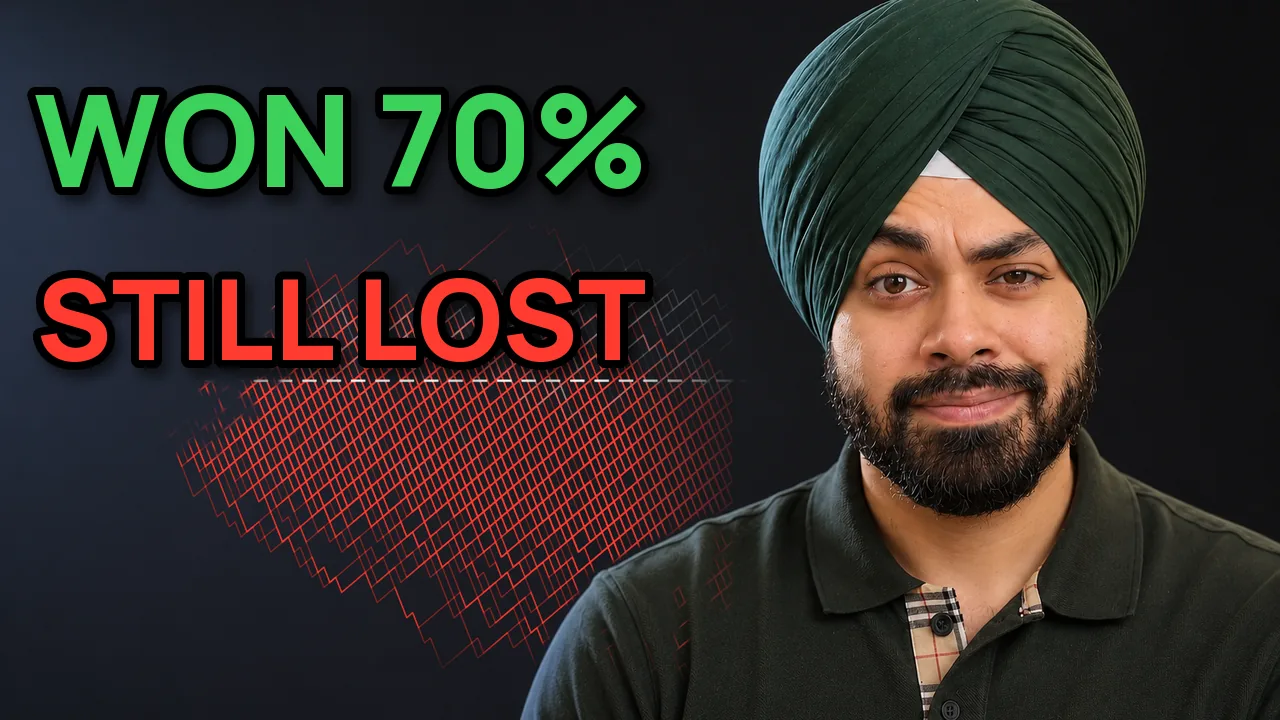
Two invented traders. The Sniper wins 70% of his trades, takes profit at half his risk (+0.5R) and lets losers run to one and a half times his risk (−1.5R). The Hunter wins only 35% of his trades, but each win is three times his risk (+3R) and each loss is one unit (−1R).
R is the amount you risk on one trade: the distance from entry to stop. Buy at 100 with a stop at 98, and 2 is one R. If the price reaches 104 instead, that is a 2R win.
The maths. Expectancy per trade = win rate × average win − loss rate × average loss. For the Sniper: 0.7 × 0.5 − 0.3 × 1.5 = −0.10R, so he loses about 10R over 100 trades. For the Hunter: 0.35 × 3 − 0.65 × 1 = +0.40R per trade.
The simulation. A computer played each trader’s numbers 20,000 times, 100 trades each run (each trade independent, no costs, fixed 1R risk). 84 in every 100 of the Sniper’s runs ended below zero. Only about 1 in 100 of the Hunter’s runs did.
The trap. Winning 35% means losing most of the time. In the same simulation, a trader like the Hunter hit ten losses in a row in about one run in three, within 100 trades, and a typical run fell 10R from its high at some point. That is where many traders change their rules, just before the maths had a chance to work.
The one rule. Size each trade so a normal losing streak cannot wipe you out. Example numbers: a 10,000 account risking 1% (100 per trade) loses about a tenth of the account in ten straight losses, and one 3R win brings back 300.
Try it. Take your last 20 trades, or demo trades: your win rate, average win and average loss. Twenty trades is only a first read. The free Risk/Reward Planner does the sum for you.
The figures in this video come from a simulation of made-up trades. They are illustrations, not anyone’s results. Trading involves risk of loss.
Get the full kit. Free.
The Trade Journal and the 39-pattern guide, sent to your inbox. Then one short note with each new video: one thing to try in your sheet. One email address, nothing else. Unsubscribe in one click and keep the files.
Start the 20-trade check: plan and log your next 20 trades, then read your own numbers.
One short email a week at most.